
In an old Var farmhouse, look down before you look up. The floor is usually the best-looking thing in the room.
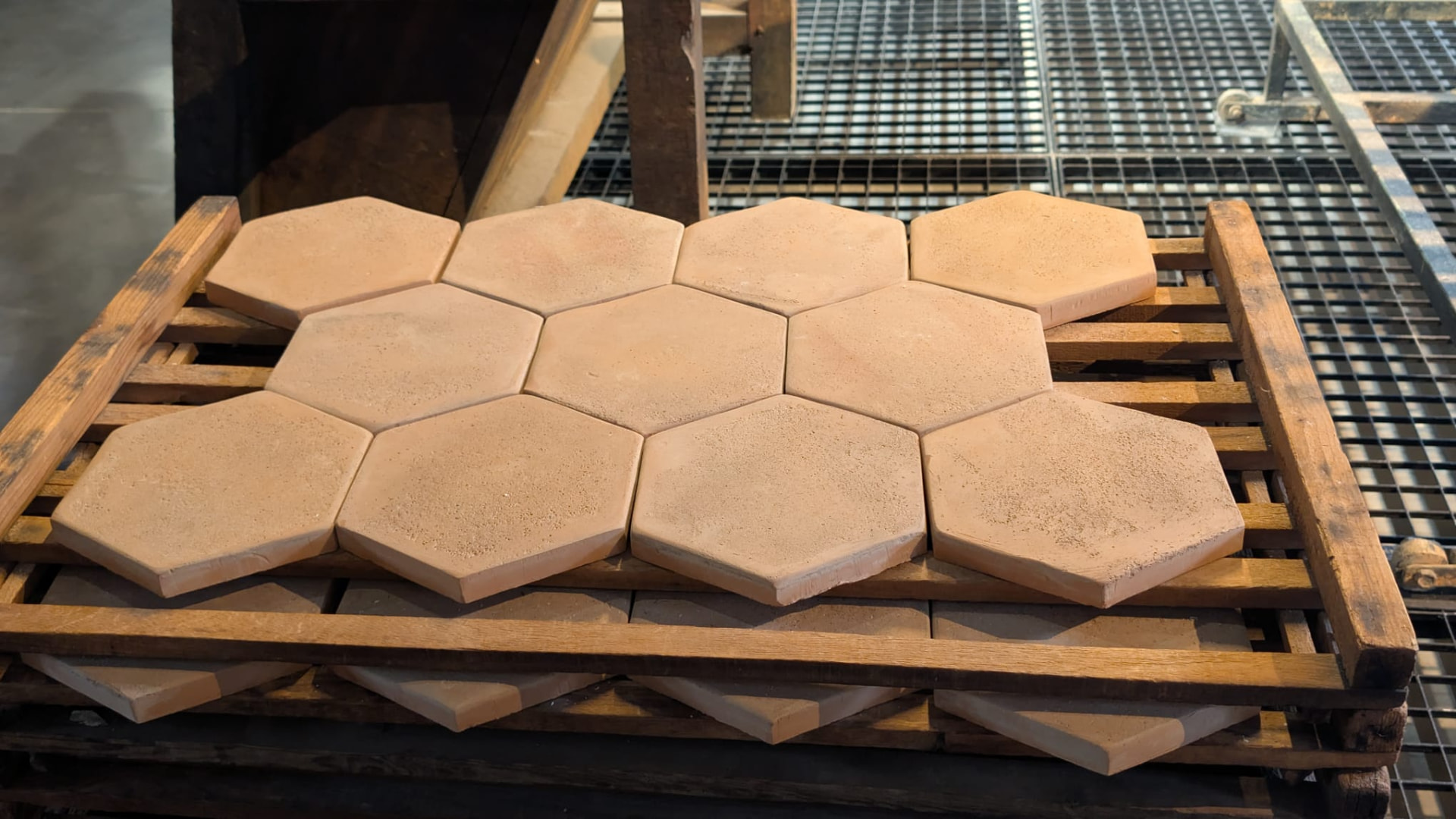
Clay has been worked in Salernes for more than 7,000 years, making it one of the oldest ceramic sites in Europe. But the tile everyone means when they say "tomette," small, hexagonal and made from the area's iron-rich red clay, only came about after an 1829 economic crisis pushed local makers to find a new product. The hexagon wasn't just decorative either, it tessellates with almost no wasted clay and minimal grout, which mattered when every batch counted and a workshop's survival depended on getting more usable tile out of the same amount of raw material.
It worked. By the mid-1800s, Salernes was exporting these tiles to Marseille, then Toulon, then Nice, and eventually across Europe and beyond, riding the same wave of building and renovation that was reshaping cities across the continent at the time. Hand-painted decoration came about twenty years later, once the plain hexagonal tile had proven itself and makers started responding to new tastes for pattern and color, moving the craft from purely functional flooring toward something closer to decorative art.
The traditional process hasn't changed as much as you'd expect. Local red clay is still dug, cleaned of stones and impurities, then pressed into the hexagonal molds, dried slowly to avoid cracking, and fired at high heat until it hardens into the deep terracotta color the tiles are known for. Hand-painted pieces get their glaze and pattern applied before a second firing sets it permanently. It's a slower process than industrial tile production, and that's precisely the appeal for anyone restoring an old property who wants the real thing rather than a modern imitation printed to look aged.
The place to see the whole story laid out is the Terra Rossa museum, the Maison de la Céramique Architecturale, housed in a converted tile factory in the village. It opens with an archaeological exhibition covering those 7,000 years, then walks through a reconstructed early-20th-century production line, and holds a collection of more than 2,000 tiles ranging from the Middle Ages to the 19th century. It also shows what local makers are producing right now for architects and designers, so the craft reads as living, not just historical, a working trade rather than a museum piece pretending otherwise. Hours shift with the season and it typically closes for the winter low season, worth confirming before a visit.
Salernes is still the place to see and buy tomettes today, from workshops continuing the same hand process: new tiles, reclaimed antique ones pulled from demolished farmhouses and resold, and hand-painted decorative pieces for anything from a kitchen backsplash to a full floor. Interior designers and architects working on renovations across Provence and beyond still source directly from these workshops rather than settle for a mass-produced equivalent. A few of the village's ceramic workshops also run occasional hands-on courses in throwing and painting, worth looking into as a bookable half-day experience rather than only a shopping stop, though we're still confirming which ateliers currently offer a session open to casual visitors rather than serious students.
Two centuries later, it's still the same red clay, the same hexagon, the same village.