
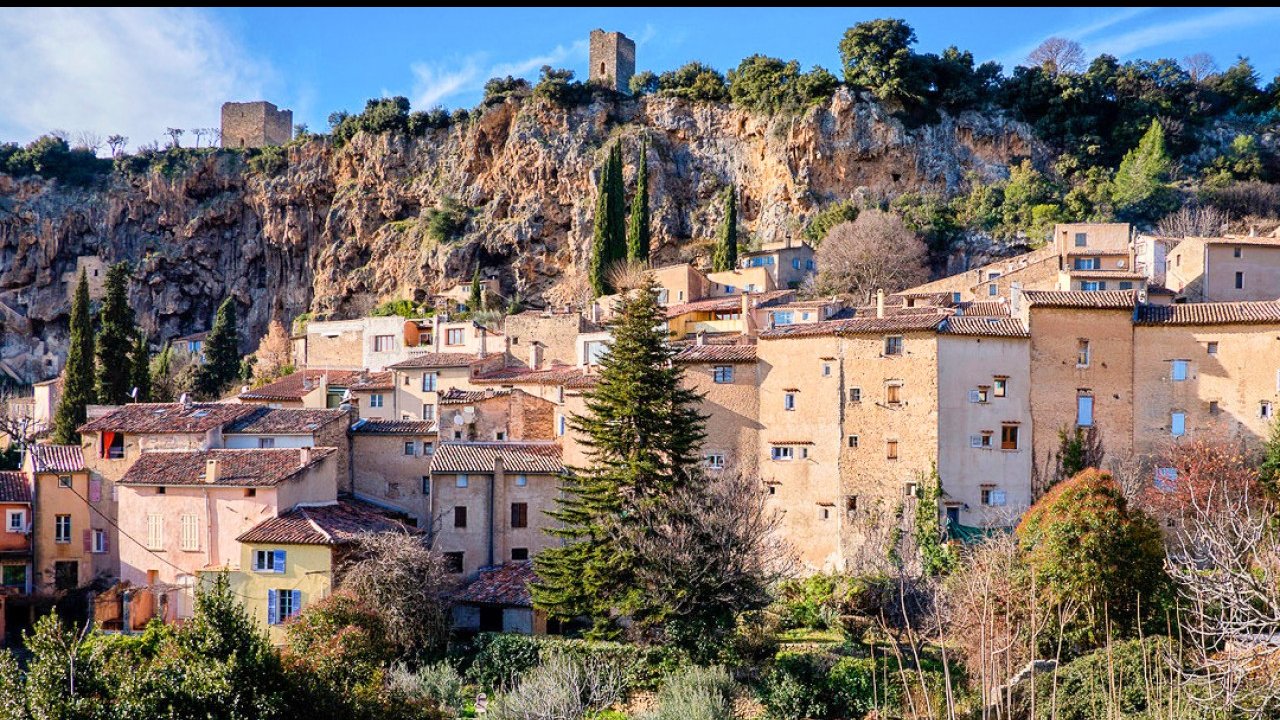
Most villages in Provence climb a hill. Cotignac tucked itself under a cliff instead, and has lived in its shadow ever since.
Long before there was a village, there was a waterfall. In the Quaternary era the Cassole river ran across the plateau above Cotignac and spilled over the edge, and over thousands of years its water laid down a wall of tufa, the soft, porous stone that gives the cliff its pitted, honeycomb face. The cascade was diverted in the 11th century. The cliff stayed, and the village grew up underneath it.
The cascade was diverted in the 11th century. The cliff stayed, and the village grew up underneath it.
Locals simply call it le Rocher, the rock. It runs about 400 meters long and rises about 80 meters above the rooftops, and from almost anywhere in Cotignac it fills the top of the view. Its hollows were put to use early. During the medieval invasions, villagers sheltered in the caves with their animals and their food, and two lookout towers, still known as the Saracen towers, went up on top to watch the approaches. Until the end of the 19th century the rock was also a working quarry. At its foot, a few old semi-troglodyte houses are still built straight into the cliff, and some have been turned into places to stay.
You can climb up into it. From Place de la Mairie, take the stairs and follow the signs for the promenade du Rocher. On your own it takes about 15 minutes, but the path has 90 steps with narrow, steep passages, and the tourist office advises against it for anyone who has trouble walking or doesn't like heights. Strollers won't make it. The last stretch is the steepest, and the reward is the view back over the village rooftops from the orientation table near the towers. Through October 31, 2026, the Rocher is open Tuesdays and weekends from 10 a.m. to noon and 2 to 5 p.m., and on the other weekdays from 2 to 5 p.m. It closes when it rains, and the winter schedule hadn't been published when we wrote this, so check with the tourist office before you go between November and June.
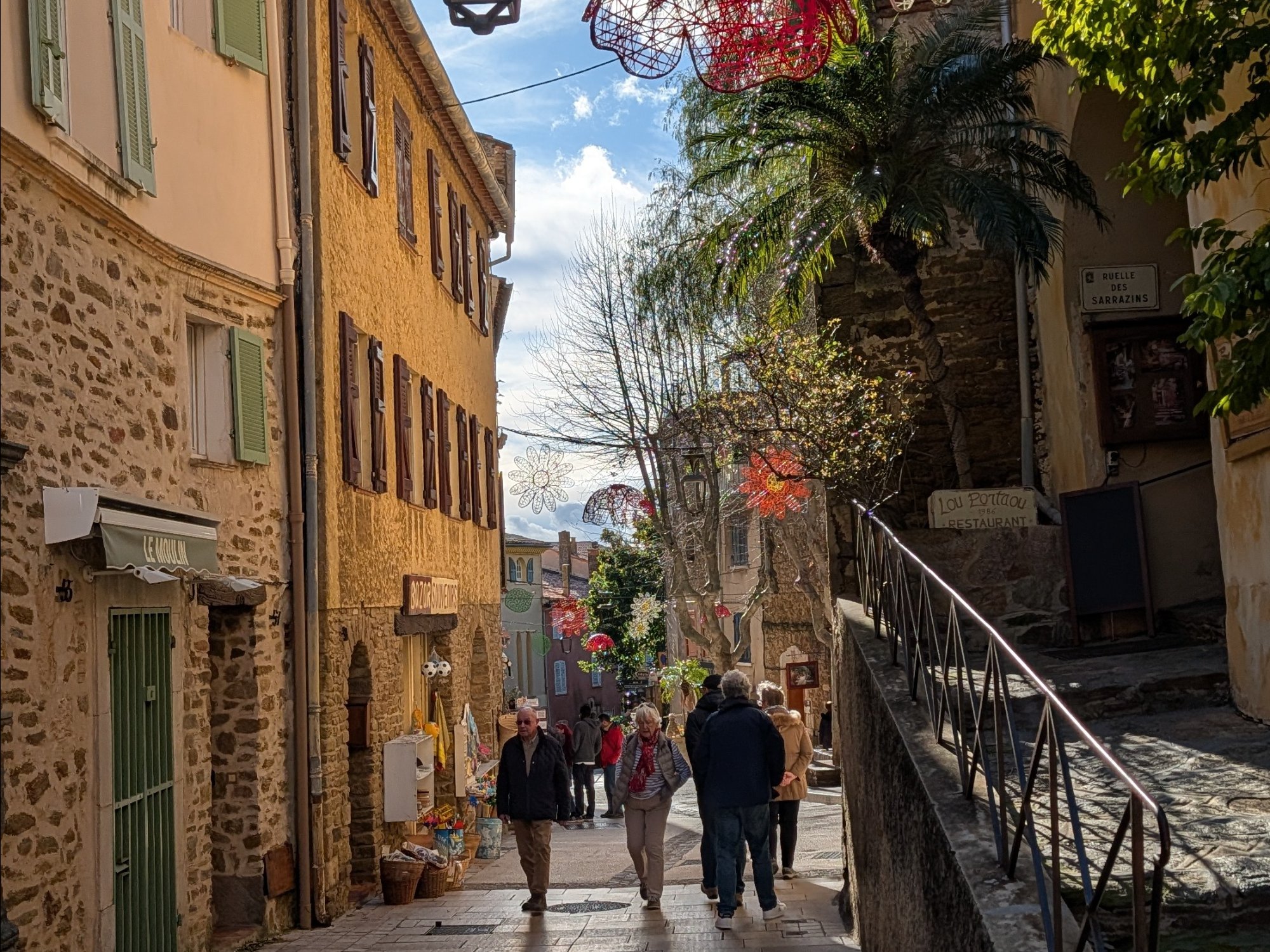
Back on the ground, village life happens along Cours Gambetta, a long avenue of old plane trees lined with café and restaurant terraces. On Tuesday mornings the weekly market sets up along the cours. It is small and distinctly local, with honey, olive oil, goat cheese and whatever is in season. Amy's rule here: find the chèvre made at the goat farm just outside the village. She calls it a must.
Cotignac is one of the Plus Beaux Villages de France, and it has a fruit to go with the title. The quince, le coing, is the village's emblem, and every autumn Cotignac holds a Fête du Coing in its streets, with a craft market, quince dishes at lunch, a quince-paste competition and a parade where people turn out in green and yellow. This year's edition was on October 25, so keep it in mind for next fall.
Then there is the sanctuary of Notre-Dame-de-Grâces, on Mont Verdaille outside the village. It was built in 1519 after reported apparitions of the Virgin Mary, and its fame comes from a royal story. In 1637 a monk, Brother Fiacre, said he had a vision that the queen, Anne of Austria, would have a son after three novenas, one of them said at Notre-Dame-de-Grâces in Provence. The future Louis XIV was born on September 5, 1638. In February 1660 the king came to Cotignac with his mother to give thanks, and the stone steps he is said to have climbed on horseback are still called the Escaliers Louis XIV. After Anne died in 1666, he had a plaque placed in the sanctuary in her memory, and you can still read it. Saint Joseph is said to have appeared on nearby Mont Bessillon in 1660 as well, and a second sanctuary stands there.
Notre-Dame-de-Grâces is free to visit and open every day from 7 a.m. to 7 p.m., and pilgrims still come in a slow, quiet trickle. Visitors are asked to dress respectfully and keep their voices down.
Cotignac works best at an unhurried pace: the market first, then the climb up the Rocher, then a long lunch under the plane trees. Stay until late afternoon, when the light comes around and the pale tufa turns gold.
The rock was here first. Everything in Cotignac still arranges itself around it.