
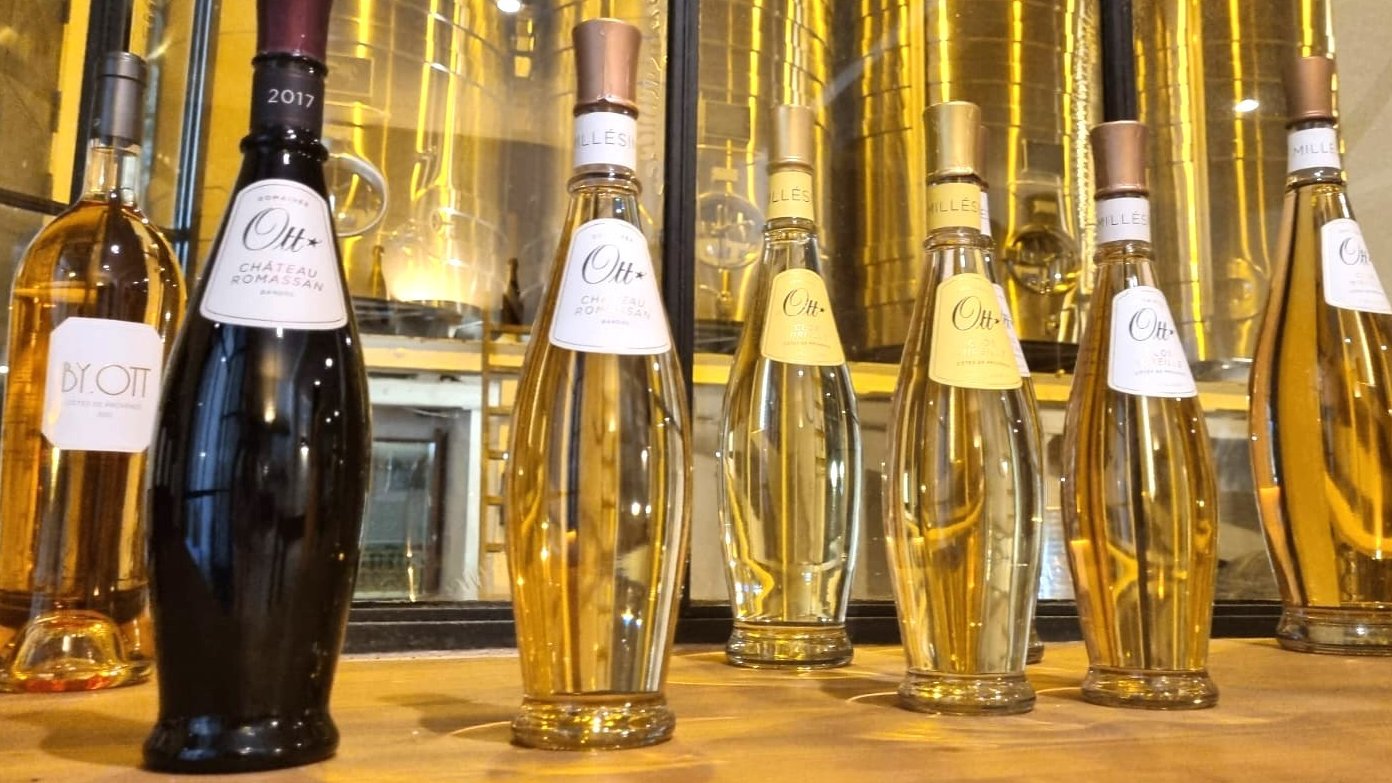
Ask anyone outside France what pink wine tastes like and they'll usually mean one thing: rosé from Provence, served cold, gone by the second glass. Ask someone who lives here and they'll ask you which rosé, because the Var alone makes three distinct styles of it, and mixing them up is the fastest way to spot a first-time visitor.
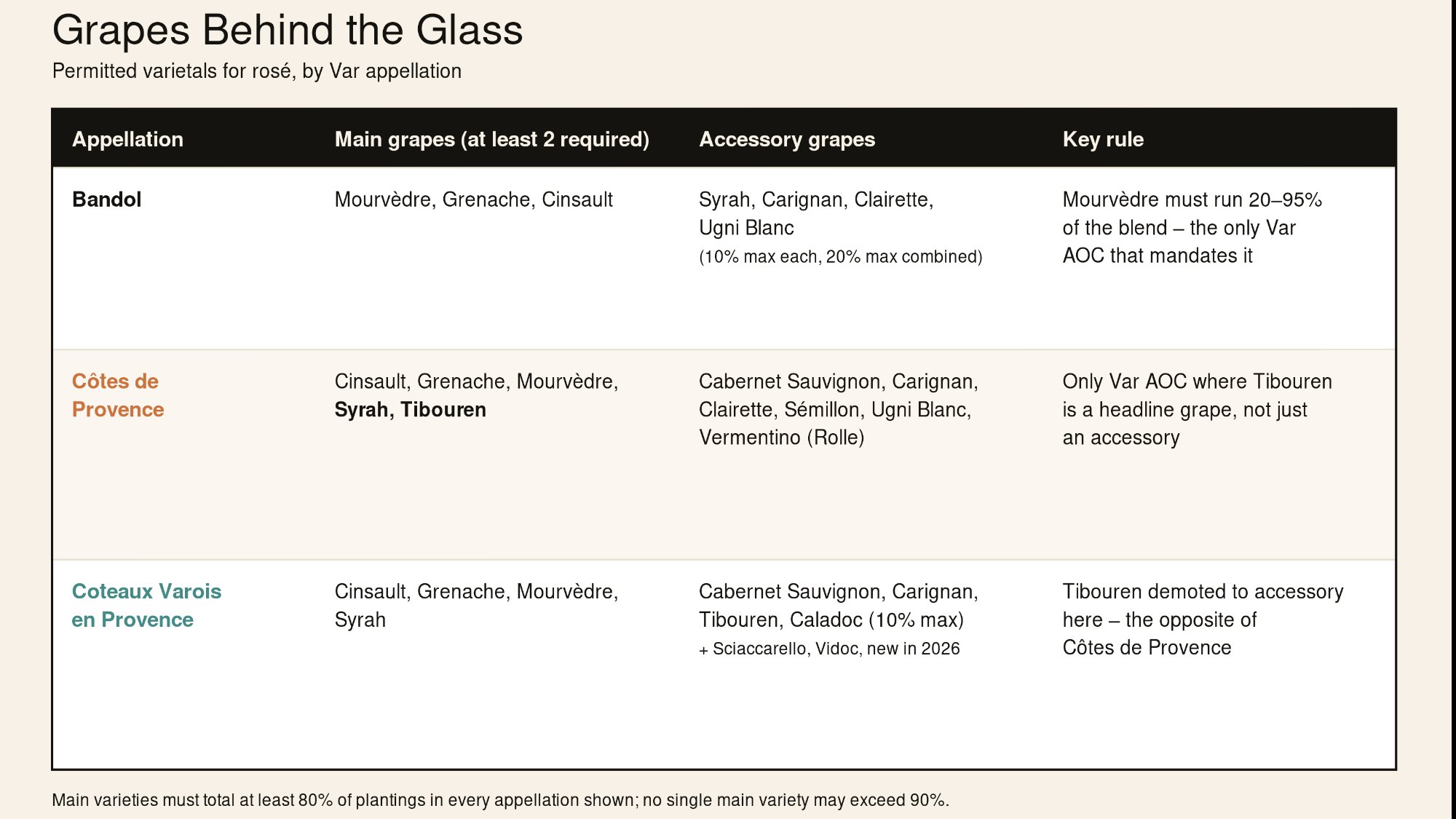
Start with Bandol, the smallest and most serious of the three. Its vineyards climb the terraced hills around Le Castellet and La Cadière-d'Azur, close enough to the coast that the Mediterranean is visible from more than a few rows of vines. Bandol's rules are the strictest here: at least two of Mourvèdre, Grenache and Cinsault have to be in the blend, and Mourvèdre alone can run anywhere from a fifth to nearly all of it, with Syrah, Carignan, Clairette and Ugni Blanc allowed only in small amounts, capped at 10 percent each. It's that mandatory Mourvèdre presence, more than any single number, that gives Bandol rosé its structure: darker, closer to salmon than the pale Provence pink most people picture, with a spice and mineral edge that can actually improve over a year or two in the bottle instead of needing to be drunk within the season. Domaine Tempier is the estate most people mention first, and rightly so, though a walk through La Cadière-d'Azur's old ramparts gates with a glass in hand tells you almost as much about why the wine tastes the way it does.
Côtes de Provence is the opposite kind of story: the biggest appellation by far, stretching across most of the department and beyond, and responsible for most of the pale, bone-dry rosé that made the region famous in the first place. Five grapes carry it, Cinsault, Grenache, Mourvèdre, Syrah and Tibouren, at least two required, none allowed past 90 percent of the planting. Tibouren is the one worth knowing by name: an old Provençal variety that shows up here as a headline grape and nowhere else on this list, prized for a lighter, more perfumed style and tied historically to the rosés of Saint-Tropez specifically. Up in the Haut Var, near the Gorges du Verdon, Château Thuerry and Château Mentone both farm at real altitude, and their wines lean brighter and more citrus-forward than what grows closer to the coast. Closer to the water, in the La Londe pocket, Domaine Figuière is one of ours, an organic estate we've written up before, worth seeking out by name.
Coteaux Varois en Provence sits between the two, geographically and in style. It's the appellation nobody outside France has heard of, and the one Stephanie actually reaches for at home. It keeps to four main grapes, Cinsault, Grenache, Mourvèdre and Syrah, with Tibouren demoted to a supporting role rather than a headline grape here. The vineyards sit higher and further inland, boxed in by the Sainte-Baume and Sainte-Victoire massifs, cooler at night than the coast gets, and that shows up as a rosé with more red fruit and a little more grip than a typical Côtes de Provence, without Bandol's weight. Two new grape varieties bred for a warmer climate, Sciaccarello and Vidoc, were just authorized here this year, worth watching for on a label in a few vintages. Château d'Ollières is a reliable place to start if a tasting stop is on the itinerary.
One thing that still catches visitors off guard: order a glass here in July and don't be shocked to watch someone drop ice cubes straight into their rosé. It threw me the first time I saw it too. There's an actual name for it, rosé piscine, literally "pool rosé," and it's less a shortcut than a genuine summer habit once the afternoon heat outpaces whatever a properly chilled glass can hold onto.
None of these three is better than the others so much as suited to a different afternoon. Bandol earns a table and a proper meal. Côtes de Provence is what belongs in the cooler at the beach. Coteaux Varois splits the difference, and is usually the one that surprises people who assumed all Provence rosé tasted the same. This is a survey, not a tasting guide, more detailed reviews of specific bottles are coming. Check back as the list grows.